






Uniform Four-Knot Stringing: Pros, Cons and Stringbed Behavior
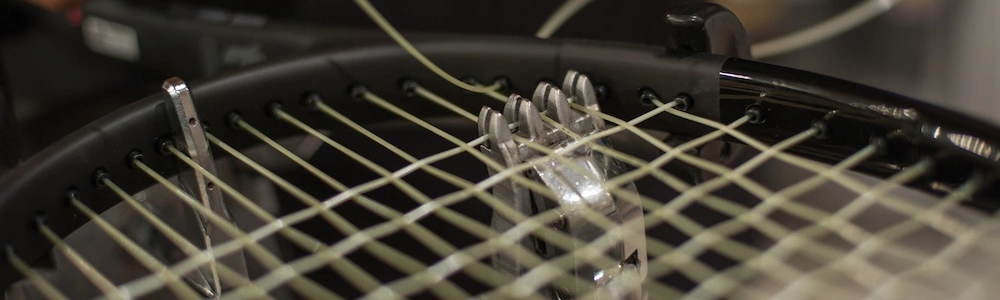
Four-knot stringing is now one of the most widely used standards in tennis, both at professional level and among advanced players. This pattern is appreciated for its mechanical consistency, ease of execution, and highly predictable stringbed behavior.
In a four-knot stringing with uniform tension, the tension applied to the vertical strings (mains) is the same as that applied to the horizontal strings (crosses).
This choice is based on a key technical consideration: during the installation of the cross strings, the presence of the already-installed mains generates friction, reducing the tension effectively transferred to the string.
As a result, even when setting the same nominal tension (for example 24 kg / 24 kg), the final outcome will still feature slightly tighter mains and crosses with a lower effective tension.
The difference between nominal and effective tension increases:
- as the coefficient of friction between the strings increases;
- as the set tension increases.
This type of stringing is often associated with a “match-ready” competitive response. It is ideal for players who prioritize control and seek a firm, direct, and predictable stringbed response, without relying on additional help in terms of power or spin.
Many advanced players choose it for its neutrality, allowing the technical gesture to fully express itself.
- Maximum control thanks to a stiff and consistent stringbed.
- Excellent performance on flat shots and slice.
- Ease of execution, with no need for differential tensions.
- Good string durability, with stable and predictable response.
- Reduced power and lower launch angle.
- More linear, penetrating trajectories.
- Lower effectiveness on topspin shots due to increased friction and reduced snap-back.
- Reduced feel and forgiveness, especially in defensive situations.
With uniform four-knot stringing, the effective stringbed tension tends to be homogeneous and consistent with the set value, with a normal initial tension loss due to settling.
The stiffness distribution often shows higher values in the upper part of the hoop, a more balanced central area, and lower stiffness in the lateral and lower zones. This favors competitive players who tend to hit higher on the stringbed for maximum directional control.
The stiffness differences across the hoop highlight how friction between mains and crosses directly affects the final result.
Uniform-tension four-knot stringing is a solid and reliable technical solution, particularly suitable for competitive and advanced players seeking control, precision, and stability.
It is generally less suitable for those looking for free power, high comfort, or enhanced spin assistance. In short, it is an “honest” setup: it gives nothing away, but returns exactly what the player puts into the stroke.
- By Gabriele Medri
- Sunday 1 September 2024
- Stringing