






How many hours should you play before changing your strings?
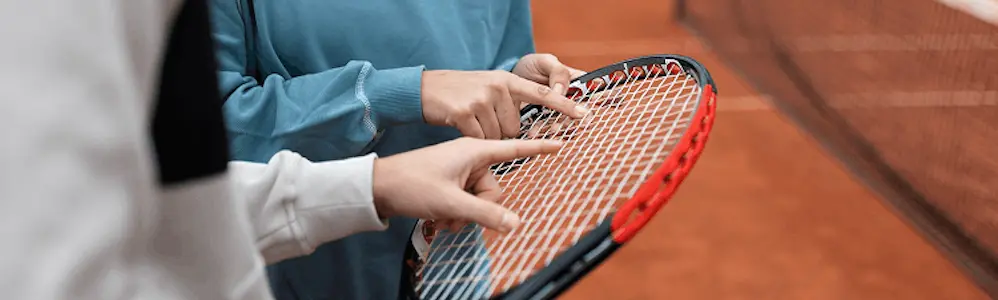
How many hours should you play before changing the strings in your racket?
5 hours? 10? 20? Once a month?
The most accurate answer is less simple than a number: there is no interval that works for everyone.
There is, however, a much more useful principle: the useful life of a string does not necessarily end when it breaks.
A string can still be physically intact while having already changed significantly in tension, elasticity, response and dynamic behaviour.
So, to understand when it should be replaced, we need to stop asking only “is it still intact?” and start asking “is it still working the way it should?”
The myth: “I change my strings when they break”
This is probably the most common criterion among recreational players: as long as the string has not broken, it is still usable.
From a purely physical point of view, that is true. From a performance point of view, much less so.
Breaking simply means the filament has reached the limit of its mechanical strength at a particular point. It does not tell us that, up to the previous shot, the stringbed was still behaving exactly as it did when new.
Physical durability and performance life are two different concepts.
A frequent string breaker may break the string before performance degradation becomes the main problem. A player who rarely breaks strings, on the other hand, may continue for many hours with a setup that has already changed significantly.
Tension loss begins long before you step on court
When we say that a racket is strung at 22 kg, we are referring to the tension set on the stringing machine. It does not mean the stringbed will remain at that value.
The material begins to relax immediately after being tensioned.
Racketpedia tests on static tension stability analyse precisely this first phase: a significant part of the initial loss occurs soon after tensioning, after which the phenomenon progressively slows down.
This means that tension is not an immutable condition, but a value that evolves over time.
Static stability and dynamic stability are not the same thing
Tension loss at rest tells only part of the story.
Once we start playing, another phenomenon comes into play: dynamic stability.
Every ball impact deforms the strings. Thousands of impacts progressively subject the material to mechanical stress and alter its response.
A string can therefore behave one way immediately after stringing and differently after several hours of play.
Static and dynamic stability should therefore be treated as complementary information: the first mainly describes the material’s initial relaxation, while the second describes its ability to preserve its characteristics during play.
A string does not only lose tension
Reducing string ageing to tension loss alone is another oversimplification.
During use, several aspects of the filament and stringbed can change:
- effective tension;
- elasticity;
- perceived stiffness;
- energy return;
- string movement and recovery;
- response to repeated impacts;
- predictability of the stringbed.
The key point is simple: a string can still be unbroken while no longer delivering the performance for which it was chosen.
The case of polyester monofilaments
This phenomenon is particularly interesting with polyester monofilaments, which are now extremely widespread.
During repeated impacts, the material is continuously deformed. Part of this deformation may progressively become permanent, changing elasticity, response and the string’s ability to return quickly to its original position.
The result can be a stringbed that remains physically intact but no longer provides the same feel and predictability as it did in the first hours.
This is one reason why, especially with monofilaments, systematically waiting for breakage may be a poor indicator of actual performance life.
Multifilament, natural gut and monofilament do not age in the same way
Not all string families evolve in the same way.
Material and construction determine both initial behaviour and how characteristics change with use.
A polyester monofilament, a multifilament and natural gut have very different structures and properties. Assigning them one universal lifespan expressed in hours would therefore make little sense.
Even within the same category, two strings can have different stability and degradation profiles.
This is exactly why Racketpedia String Lab Tests measure tension maintenance as a characteristic of the individual string rather than inferring it simply from its category.
How can you tell when performance is changing?
Degradation is not always sudden. It is often progressive, and the player gradually adapts to the change.
Some signs may indicate that the setup is no longer responding as it did in the first hours:
- less predictable trajectories;
- a different feeling of control;
- less consistent response from shot to shot;
- the need to adjust your stroke progressively to obtain the same result;
- a clear change in impact feel;
- strings moving and no longer returning as they did before;
- loss of the familiar feeling of responsiveness.
None of these signs, taken individually, automatically means the string must be replaced. Together, however, they help show that the behaviour of the system is changing.
So: 5, 10, 20 or 30 hours?
This is where it would be easy to build an apparently simple table:
“This type of string lasts X hours, that one Y.”
But that would be an excessive simplification.
Performance life depends on many variables:
- string type and model;
- gauge;
- initial tension;
- string pattern and racket characteristics;
- impact intensity;
- amount of spin generated;
- player level and technique;
- frequency of use;
- the level of performance the player considers acceptable.
The same number of hours does not represent the same stress for every string and every player.
Hours of play are more meaningful than the calendar
“I change my strings every three months” sounds precise, but in reality tells us very little.
For one player, three months may mean eight hours of tennis. For another, fifty.
When assessing how a string job evolves, actual hours of use are generally far more meaningful than simply counting calendar time.
Even hours need interpretation: ten hours of play do not necessarily stress a string equally for a casual player and for a competitive player who hits with high speed and spin.
Breakage frequency changes the problem completely
Some players break strings after only a few hours, while others could play with the same strings for months without breaking them.
In the first case, mechanical durability may naturally determine replacement timing.
In the second, the limiting factor may be mainly performance.
That is why two players using the same string can have completely different replacement intervals without either of them necessarily being wrong.
The role of Racketpedia Lab Tests
Racketpedia String Lab Tests go beyond the simple commercial classification of a string.
The analysed parameters include characteristics related to stiffness, elasticity, resilience and tension maintenance.
These data show that two apparently similar strings may start from different characteristics and, above all, may evolve differently.
Racketpedia does not turn these measurements into a universal expiry date such as “change this string after 12 hours”.
Instead, laboratory data helps answer a more useful question: how well is this specific string predisposed to preserve the characteristics we are looking for over time?
Tension holding is a characteristic of the individual string
In the Racketpedia database, Tension Holding is one of the behaviours used to analyse and compare strings.
This matters because it prevents us from reasoning only through broad categories.
Two monofilaments of the same gauge can have different characteristics. The same applies to two multifilaments or two strings apparently aimed at the same type of player.
The exact model matters.
From the laboratory to the court
The laboratory describes the characteristics of the string. The court tells us how those characteristics interact with the player.
| Information | What it helps us understand |
|---|---|
| Static stability | How tension evolves immediately after stringing |
| Dynamic stability | How much the response changes under repeated impacts |
| String characteristics | Stiffness, elasticity, resilience and material behaviour |
| Hours of use | How long the setup has actually been exposed to play |
| Player feedback | When the change becomes genuinely noticeable or detrimental |
It is the combination of this information, not one single number, that describes the true useful life of a setup.
Do not necessarily wait until something goes wrong
One of the best ways to understand the performance life of your strings is to observe how the setup behaves over time.
If a particular racket, string and tension combination feels excellent for the first few hours and then consistently changes after a certain amount of play, that information becomes extremely useful.
After a few restringing cycles, you can build a genuine personal baseline.
Not a universal rule, but a rule based on your own game.
The right question is not “Have they broken?”
Strings are a performance component of the racket, not simply something that needs to remain physically intact.
Waiting for breakage may make perfect sense for some players. For others, it means playing for many hours with a setup that has already changed significantly.
That is why there is no universal answer to the question “how many hours should I play before changing my strings?”
There is a much more useful question:
“Are my strings still delivering the performance I expect from my setup?”
Racketpedia helps explain how a string is built and how it tends to behave. Experience on court helps determine how long that behaviour remains suitable for the individual player.
Do not necessarily wait for the string to break. Learn to recognise when it has stopped being the string you originally chose.
- By Racketpedia Team
- Sunday 27 September 2026
- String Characteristics, Stringing